
Pursuing a medical negligence claim may appear terrifying at first, especially given that the vast majority of people have never gone through the process before.
The goal of this blog is to provide a quick overview of the process, from initially contacting our firm until a favourable result.
Step-by-step guide on how to file a medical negligence claim?
Step #1. Initial Enquiry: Your First Contact With Us
A simple discussion marks the beginning of the adventure. Kindly provide an overview of your issue by contacting our medical negligence team either via phone or through our online enquiry form. You’ll explain why you believe your care fell short and what harm it caused. One of our experts will go over the information you provided and determine the following:
- Whether your case is within the legal time limit can affect your claim for compensation.
- If there are fair chances of success, you may be eligible for medical negligence compensation.
- Whether the expected compensation value justifies going ahead.
Step #2. Funding Your Claim
Do you have concerns regarding the amount of money required to file a claim? You should not feel alone.
There are several methods for funding a medical negligence claim, including:
- Legal aid (offered exclusively for extremely specific types of situations)
- Legal expenses insurance, which may be included in home or auto insurance policies.
- No Win, No Fee agreements are the most common available choice.
With a No Win, No Fee agreement, you will not pay anything up front and will only pay if your case is successful. We’ll thoroughly explain your alternatives and assist you in choosing the best one for your specific situation.
Step #3. Gathering Your Medical Records
If you decide to proceed, the next step is to get and assess your whole medical record. With this information, we will be able to construct a better understanding of your care, determine whether or not negligence occurred, and prepare the particulars of the claim.
The following people will assess your records:
- An in-house nurse who can provide clinical insight
- A lawyer with a background in the field of medical negligence law
We will determine whether your care fell short of the required standard (breach of duty) and if this caused your harm or worsened your condition (cause).
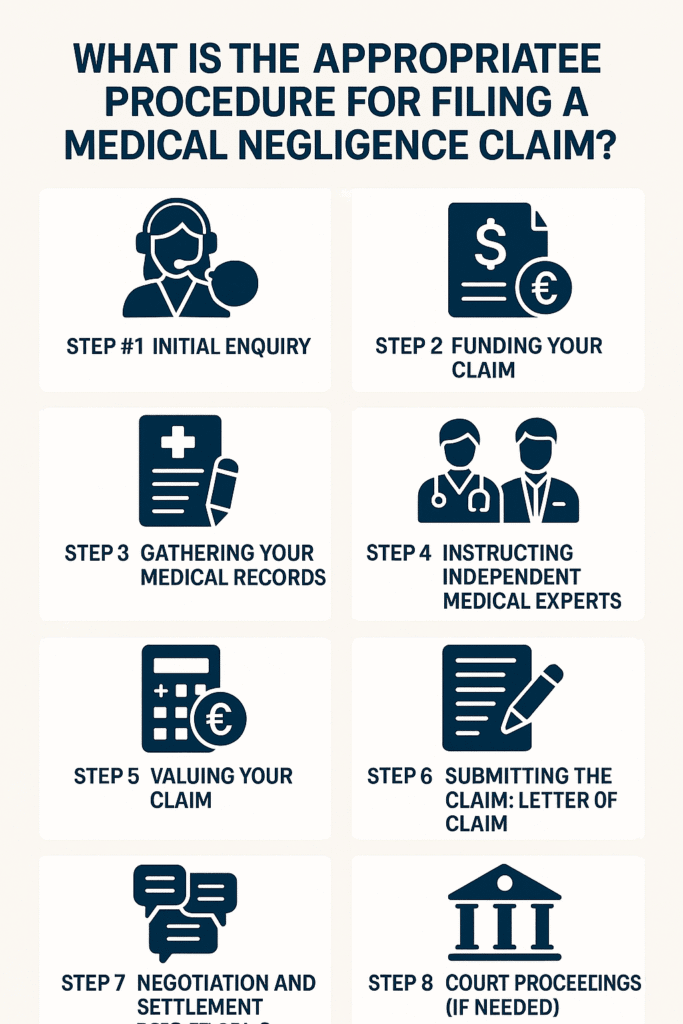
Step #4. Instructing Independent Medical Experts
To prove medical negligence, we must confer with unbiased medical professionals.
- Review your records
- Provide written reports
- Possibly examine you in person
Experts can only provide opinions specific to their area of expertise. GP care, for instance, is not something that an orthopaedic surgeon can comment on without sufficient medical evidence. This means that, depending on the intricacy of your case, multiple specialists may be required.
These reports help identify the mistakes made in your care and how those mistakes have impacted your life, both now and in the future, providing vital medical evidence.
Steps #5. Valuing Your Claim
Two primary components decide the amount of compensation for medical negligence:
- General Damages: for your pain, suffering, and loss of amenity
- Special Damages: for financial losses such as: Travel and treatment costs Loss of earnings Help or care from family or professionals Future needs, like home adaptations or mobility aids
To assist you in determining the value of your claim, we will consult existing case law and expert opinions on your recovery prospects.
Step #6. Submitting the Claim: Letter of Claim
Once we have supporting documentation, we will create and deliver a Letter of Claim to the defendant (often the hospital, doctor, or healthcare provider). As outlined in this letter:
- What went wrong
- Why was it negligent
- The impact on your life
The defendant has four months to respond. They are able to either accept that they are at fault, reject it, or ask for more proof.
Step #7: Negotiation and Settlement Discussions
If the defendant acknowledges that they are at fault, we will proceed to discuss the amount of compensation. Our specialists will look into their response to determine whether or not your case needs to be brought before a judge if they deny responsibility.
Settlements can often be reached through written offers or meetings between legal representatives. We always strive to resolve matters without a trial.
Step #8. Court Proceedings (If Needed)
If the case does not settle or liability is challenged, we may proceed to court. It is not always the case that there will be a trial when a claim is initially filed in court.
The court will set up a schedule that will include the following:
- Exchanging witness statements
- Sharing expert reports
- A possible joint meeting between both parties’ experts
If the dispute cannot be resolved through this process, a judge will consider the evidence and make a final decision during the trial. We will be there for you every step of the way if a hearing is required, but most cases are resolved before this stage.
How Long Does Making a Medical Negligence Claim Take?
The time frame varies depending on the complexity of the case, but most claims take 12 to 36 months from start to finish. Regular updates and direction will be provided to you during the process.
Conclusion
Making a claim for medical negligence can be stressful, but understanding the procedure step by step might make it easier. From the initial inquiry and the collection of documents to the mailing of the Letter of Claim, receiving of a letter of response, and, if necessary, the filing of a claim form in court, our team of experts is here to advise you through every stage of the process, regardless of whether your medical care was given by a private provider or an NHS Trust.
We will assess your clinical negligence case, examine various funding sources such as “No Win, No Fee,” and collaborate with independent specialists in order to create a compelling argument. While it is true that many compensation claims are resolved without going to trial, our primary objective is to ensure that you get the right compensation amount for the injury that you have suffered.
Don’t wait if you think you’ve been the victim of carelessness; act immediately. Most medical negligence cases have stringent time constraints, often as little as 14 days for first measures in urgent cases.
It is important that you get legal advice as soon as possible, even if you are unsure whether or not you have a valid claim.
Get in Touch Today
Our professional medical negligence solicitors at Criminal Defence Lawyers Scotland are here to help you understand your rights and get the compensation you deserve. We are experienced, empathetic, and dedicated to providing the best possible solution for each client. Get in touch with us today!